Mapping modulators of T-cell activation and cancer immune evasion through chemical and genetic perturbations using an in-vitro co-culture system
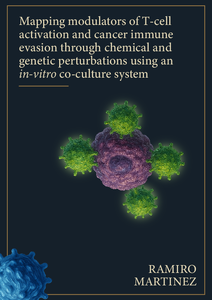
The primary goal of this thesis was to examine immune-evasion mechanisms employed by melanoma cells, focusing on long non-coding RNAs (lncRNAs) and FDA-approved compounds as potential immunomodulators. Although immune checkpoint inhibitors targeting PD-1/PD-L1 have transformed melanoma therapy, many patients still experience resistance. To explore this, I developed a co-culture model pairing melanoma cells (MALME-3M or SK-MEL-5) with a reporter T-cell line (2D3), both engineered with dCas9-KRAB-MeCP2 for CRISPR interference, enabling systematic gene knockdown. This platform allowed me to evaluate (i) melanoma-specific lncRNA perturbations and (ii) T-cell–specific lncRNAs via arrayed and pooled CRISPRi screens. Additionally, a high-throughput screen of 2,547 FDA-approved compounds was conducted to identify agents capable of reversing tumor-induced immunosuppression. Initial results indicated that MALME-3M primarily suppresses Tcell responses through PD-L1, whereas SK-MEL-5 inhibits T-cell activity mainly through reduced antigen presentation. An arrayed cloning-free CRISPRi screen in MALME-3M, targeting 100 interferon-inducible or highly expressed lncRNAs combined with shallow RNA sequencing, identified several lncRNAs with potential immunomodulatory roles. Concurrently, a pooled CRISPRi approach in T-cells uncovered putative lncRNA regulators involved in T-cell activation. The compound screening revealed promising hits with contextdependent efficacy, specifically boosting T-cell responses in conditions where melanoma cells employed either PD-L1mediated suppression or impaired antigen presentation. Future studies will focus on validating these lncRNA targets and identified compounds in 3D organoids, in vivo models, and more immunologically complex co-culture systems, with the ultimate goal of enhancing T-cell–mediated tumor clearance in melanoma and potentially other solid tumors.
Ramiro Martinez
Doctoral Fellow (10/2019-05/2025)
Tumor immunology and immunotherapy - Pooled Screens